

Seawinder
-
Posts
1,822 -
Joined
-
Last visited
2 Followers

Recent Profile Visitors
5,794 profile views


Seawinder's Achievements

Very Obsessed Member (5/9)
1.4k
Reputation
-
Britmodeller? the right place....please a quick info on Spitfire MK I
Seawinder replied to pupaxx's topic in Aircraft WWII
This isn't quite what you're after, but it may help: On two 1/48 Spits I've built -- Mk. I from Airfix and Mk. V from Eduard -- the ejection chutes are all the same size and measure a bit over 3mm fore-and-aft. That translates to right around 6 inches full size. In 1/32 scale that would be 4.65mm or .183 inch. -
Starting a 1/48th Bristol Bulldog and have questions.
Seawinder replied to Colin 17's topic in Aircraft Interwar
The green anti-glare shade was called NIVO (Night Invisible Varnish Orfordness). Here's a link to a discussion on the subject (hope this doesn't anger the mods): https://www.key.aero/forum/historic-aviation/147340-colour-code-for-anti-glare-green-on-bristol-bulldog I used some FS 34096 on the one I built. -
That's the route I took with the Ki-84 I built some years ago. I went with what I read at the time: the under surface color was #7 lightened with white. Worked quite well I thought.
-
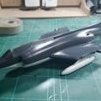
Mike Lents (McLents), who is now a member of my IPMS chapter, brought a rather striking NMF Ki-84 to the June meeting. It's in markings for the People's Liberation Army Air Force (Communist China). The decals are from Kora (Czech).
-
FWIW I used one from Quickboost and thought it looked fine.
-
Brilliant, Troy! I had completely forgotten about starting that thread fifteen years ago. This time around it'll be an Eduard kit.
-
Thanks Troy. The profile in the Barracudcals set shows the painted over wing roundels in Dark Earth. I guess that makes sense since they were using mostly Dark Earth to over-paint the Dark Green? I found a closeup photo of the rear end of UM-C, the plane I'll be doing. There's no obvious over-paint of the fuselage roundel, and the pilot is obscuring the fuselage stripe. Educated guess would be that they used DE and DG to over-paint the stripe following the existing camouflage scheme. Possible? FWIW that's the way it's shown in the Barracudcals instructions.
-
I'll be doing one of the UM- marked Mk. VIIIs of 152 Sqn. in the SEAC theatre. These planes carried the small roundels in two shades of blue. I'm wondering if the upper wings and fuselage originally had normal roundels which would have had to be painted over for the small SEAC markings. The BarracudaCals instructions for UM-C and UM-T show painted-over circles on the wings, but not the fuselage. The Eduard instructions in their Mk. VIII kit show no painted-over circles on wings or fuselage. Does anybody know the truth? Thanks! Pip
-
Sorry, wasn't meaning to crack a joke. Here's what AI offers for differences between the Gold Series and earlier kits: • Corrected Shape & Engineering: Early baseline Kinetic F/A-18 releases had minor shape issues, such as a slight error with the tops of the vertical stabilizers. The Gold Series corrected these inaccuracies. • Upgraded Decals: Regular boxing decals were sometimes heavily criticized. Gold Series kits feature premium, top-tier decals (often printed by Cartograf) with minimal carrier film. • Refined Fit: Modelers frequently note that parts on the Gold Series builds drop into place with greater ease than older releases, which notoriously required careful dry-fitting and filling, particularly around the nose. • Added Detail & Photo-Etch: Gold Series kits typically include enhanced detailing, including photo-etched metal parts (like canopy mirrors and pilot restraints) and highly specific modular nose sections depending on the exact aircraft variant (A, C, or D). Having built one, the Gold Series pretty much fixes a major fit issue: the forward canopy. One thing they haven't fixed is the instructions, which are still vague and sometimes inaccurate, with some parts cross-labeled. Not an impossible barrier, and there are plenty of build reviews that clarify things.
-
Packaging. You've already been to Scalemates. The Gold series boxes are clearly labeled as such.
-
Depends on which version of the F/A-18 you want. For an -A/-C/-D (legacy), although the older Hasegawas are still pretty good, I think the newer Kinetic kits are the way to go, but make sure you get one of the Kinetic Gold boxings. For the Super Hornets, the choice is cloudier. Meng, Hobby Boss and Hasegawa all have plusses and minuses. I went with Meng, and it's quite good, but the engineering of the rear fuselage seams requires a lot of filling and smoothing because they didn't align the seams with panel lines. This may be true with any of the kits. I suggest you do some review browsing.
-
I think Troy nailed it. Measuring the roundel and letter on my screen and doing a simple proportion yields 20 inches for the codes.
-
Step one: pour some MRP into your paint bottle. Step two: pour in some Mr. Color. Step three: stir and thin to taste. Really trouble-free.
-
I'm working on an Eduard HF Mk. VIII (early rudder, extended wing tips). It supplies clear pieces for under-wing nav lights inboard of the extended wing tips, which makes sense since the extended tips don't seem to have had any. My question: were the under-wing nav lights retained on the later Mk. VIIIs with normal-length tips that had light fixtures built in? I know the wing tips were interchangeable, but the extended ones seem not to have been used very far into Mk. VIII production. Thanks! Pip
-
I question your physics. The reflectivity of an object doesn't change its coherence in a reflected image. One can, I think, clearly see the difference of reflectivity between the wings/horizontal tail and the fuselage. Moreover, how/why would a plane flying in obviously fair weather (puffy clouds notwithstanding) have wet wings?